
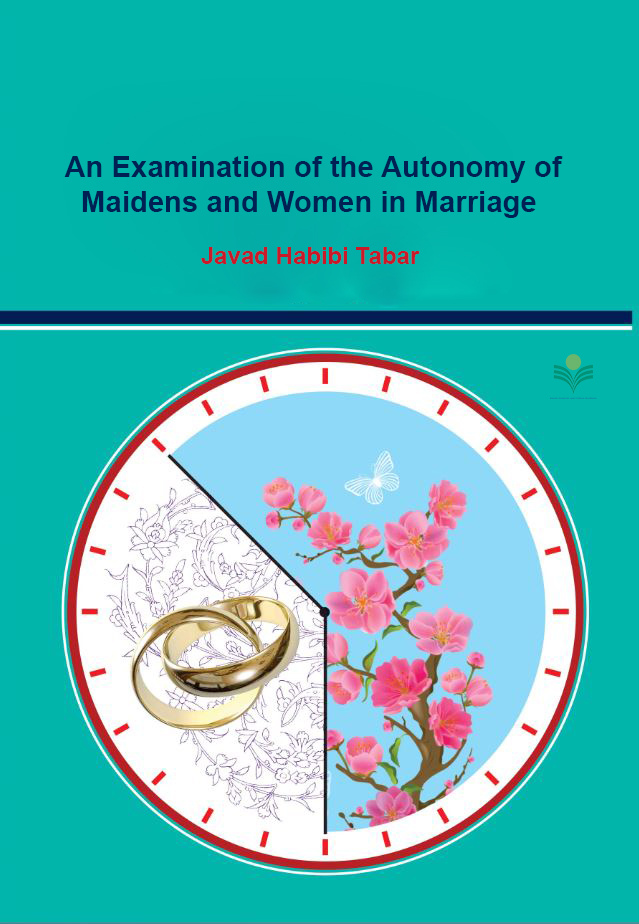
Authored by: Javad Habibi Tabar[1]
Keywords: Marriage, Virginity, Marital Maturity, Transactional Maturity, Guardianship
Problem Statement
In contemporary societies, the phenomenon of early puberty on the one hand and delays in forming families on the other have become prevalent. The peak of young people’s sexual needs coincides with the period between puberty and family formation. If religious institutions within society fail to deal with this natural need, destructive phenomena such as cohabitation, “white marriage” (unofficial marriage), and other forms of illicit relationships may become widespread and lose their moral stigma. One of the primary obstacles in resolving this issue is the theory requiring a guardian’s permission for the marriage of a virgin. This research focuses on examining this challenge.
Primary and Secondary Questions
Based on the principle of non-guardianship, what is the rationale for the need for the guardian’s permission in the marriage of an unmarried virgin woman of legal maturity? Assuming guardianship in marriage is established, who is considered the guardian of an unmarried woman of legal maturity, and what are the conditions for the exercise of guardianship by them? In permanent marriage, what is the ruling on the marriage of an unmarried woman of legal maturity without the permission of her legal guardian? What is the ruling on the temporary marriage (mut’ah) of an unmarried virgin woman of legal maturity without the permission of her guardian?
Objectives
The aim of this study is to identify a legitimate Islamic solution to address the sexual needs of youth through lawful means by examining the theoretical foundations of guardianship over the marriage of an unmarried virgin woman of legal maturity, whether in temporary or permanent marriage. Achieving this objective seeks to prevent the spread of societal issues such as cohabitation, “white marriage,” and other forms of illicit relationships, which pose significant obstacles to the establishment of stable family units.
Methodology
Identifying the opinions and views of jurists by referring to sources and literature review, and evaluating these views based on jurisprudential evidence derived from the primary sources of Islamic jurisprudence including the Quran, Sunnah, consensus, and reason. The methodology incorporates the consideration of temporal and spatial elements in the ijtihad-based analysis of this evidence, following the principles of jurisprudential inference. It also involves uncovering the intent of Islamic law (madhāq al-sharīʿah) to gain an accurate understanding of the concepts and scope of guardianship in the marriage of an unmarried virgin woman of legal maturity (both in permanent and temporary marriages) through written data. Additionally, in some cases, scientific software and computer-based systems are used for descriptive and analytical data processing.
Structure
Based on the structure of this study, the first chapter delves into the conceptual analysis of key terms, including virginity, transactional maturity, marital maturity, and guardianship. It also addresses the existence or absence of the principle of guardianship, the types and scope of guardianship, and the general conditions for a guardian as foundational concepts. In the second chapter, the specific instances of guardians in the context of marriage are identified, with these instances being exclusively defined from the perspective of Imamiya jurisprudence. The third chapter examines the necessity or lack thereof of the guardian’s permission in both permanent and temporary marriages involving an unmarried virgin woman of legal maturity. The views of jurists are first presented, analyzed, and critiqued, leading to the affirmation of the most accurate theory. The fourth chapter takes a foundational approach, assuming that a natural guardian has the right to intervene in the marriage of an unmarried virgin woman of legal maturity. It explores the limitations of the guardian in exercising this right, the factors that lead to the forfeiture of such guardianship, and examines the conditions under which guardianship can be exercised or invalidated in the context of marriage.
Novelty
While guardianship in the marriage of an unmarried virgin woman of legal maturity is not a newly emerged topic, this study establishes that the opinion rejecting the necessity of obtaining a guardian’s permission for the marriage of an unmarried virgin woman of legal maturity is a highly prominent view in Shia jurisprudence. Furthermore, it demonstrates that a temporary marriage with an unmarried virgin woman of legal maturity without the guardian’s permission is not only valid but also not prohibited as a moral obligation. However, the permissibility of such a temporary marriage does not equate to the allowance of all sexual gratifications throughout the duration of the marriage. Specifically, the act of virginity removal under such a marriage is categorically forbidden, both legally and morally.
Results
- In matters of marriage, a legal guardian (wali qahri) holds no authority over an unmarried virgin woman of legal maturity, neither in temporary marriage nor in permanent marriage.
- Assuming the existence of guardianship, if it is evident that the guardian’s opposition to the marriage of their dependent contradicts their well-being—such as protecting them from sin—then the guardian’s authority is nullified.
- Young individuals can fulfill their sexual needs through lawful marriage without feeling guilty or sinful. Additionally, since obtaining the guardian’s permission is not required, issues of modesty and shyness will not push young people toward committing illicit acts (sifah) to avoid their families’ awareness. On the other hand, as the removal of virginity in such a marriage is prohibited, the desire for permanent marriage remains intact, and no complications arise in their subsequent permanent marriages.
[1] Associate Professor, Al-Mustafa International University and Head of the Department of Jurisprudence and Judicial Law (prof.javadhabibitabar@yahoo.com).