

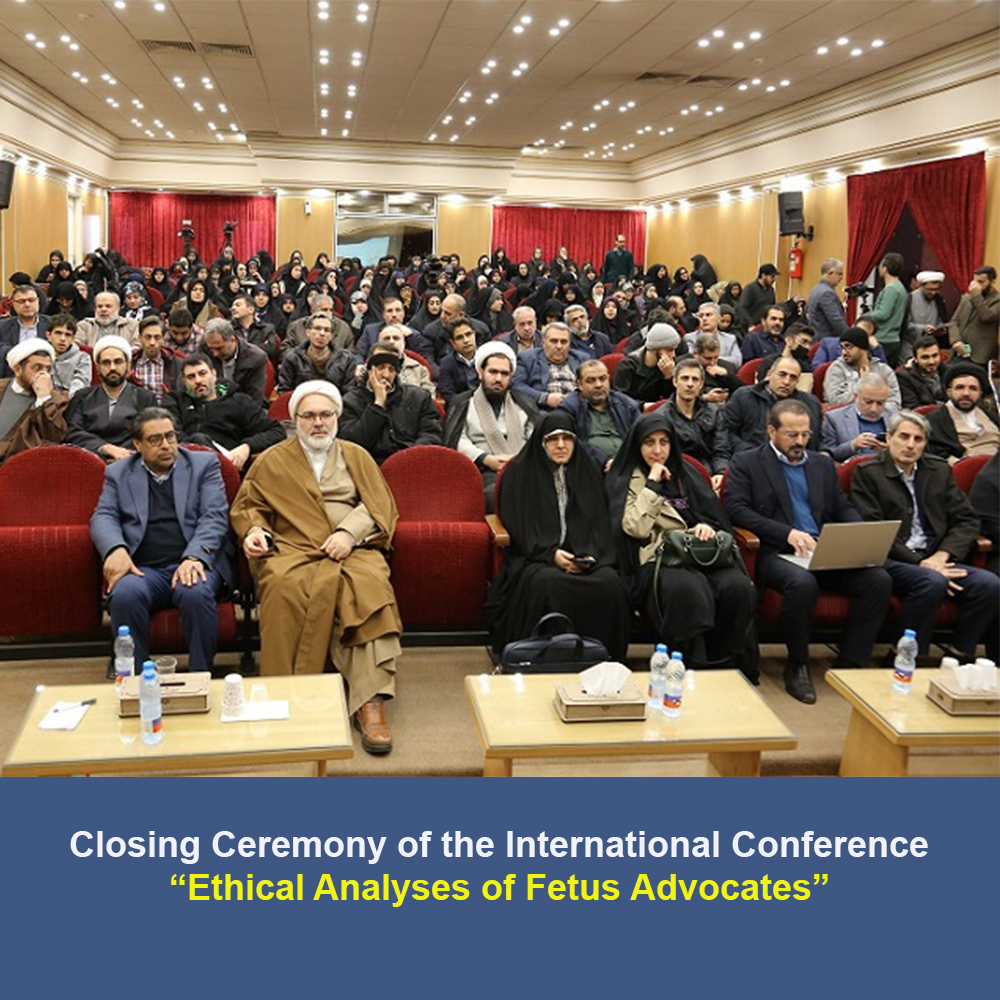
Report on the Closing Ceremony of the International Conference
Ethical Analyses of Fetus Advocates
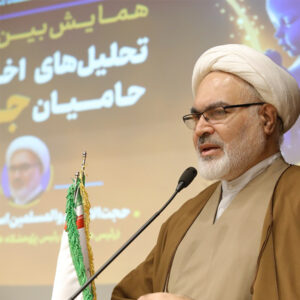
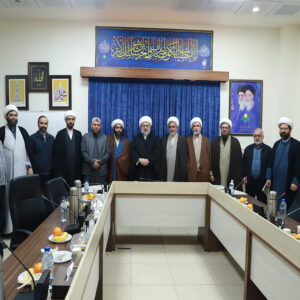
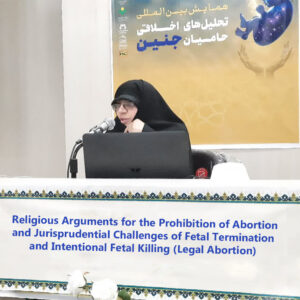
The International Conference on Ethical Analyses of Fetus Advocates was held and organized by Islamic Sciences and Culture Academy on January 27, 28, 29, 2026, with the participation of prominent religious scholars from many different countries at Ghadir Conference Hall, Qom, Iran.
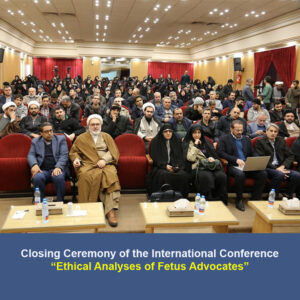
According to the Public Relations Office of the Office for the Propagation of the Islamic Seminary of Qom, the closing ceremony of the International Conference “Ethical Analyses of Fetus Advocates” was held at the Sheikh Tusi Hall of the headquarters building of the Office for the Propagation of the Islamic Seminary of Qom.
The conference addressed the ethical, jurisprudential, and legal dimensions of abortion, emphasizing the importance of preserving the life and human dignity of the fetus. Speakers stressed the need to reform media approaches, pay closer attention to the spiritual identity of human beings, and condemn abortion.
Emphasis on Ethical Dimensions of Abortion
At the beginning of the ceremony, Dr. Alireza Alebouyeh, Scientific Secretary of the Conference and Associate Professor at Islamic Sciences and Culture Academy, highlighted the necessity of addressing abortion from an ethical perspective. He stated:
Why should we address the ethics of abortion? Ethics has three fundamental functions, which unfortunately we sometimes fail to properly convey to the public:
- Its impact on the moral agent: Every ethical or unethical act shapes one’s inner identity.
- Its impact on others: Our behavior positively or negatively affects other human beings.
- Its impact on the universe: According to Quranic verses, our voluntary actions are connected to the cosmic order and can either bring down or withhold blessings from the heavens and the earth.
He added that the most significant impact is the effect on the individual’s own inner self. When a person enters the intermediate realm (barzakh) and their spiritual perception is unveiled, they witness the reality of their own being and the harm they have inflicted upon their inner self. At that moment, they plead for a return to worldly life, but no return is possible. He emphasized that such conferences serve as a wake-up call for moral awareness.
Statistical and Legal Perspectives on Abortion
Next, Dr. Reza Saeedi, Head of the Center for Population Youth, Family Health, and Schools at the Ministry of Health, presented statistical data on abortion. He noted that approximately 30–50 percent of pregnancies end in spontaneous abortion, mostly due to fetal abnormalities or genetic issues, which can be considered a form of natural filtering. However, some of these cases result from medical conditions such as hypothyroidism or hyperthyroidism, which are preventable through proper medical care.
He explained that the primary societal concern revolves around induced (intentional) abortions, which are divided into legal and illegal cases. Illegal abortions, often performed in unsafe and non-medical environments, pose serious risks to the mother’s life.
Dr. Saeedi stressed the importance of regulatory enforcement, stating that under Article 61 of the law, the Ministry of Health, the Judiciary, and supervisory bodies are required to confront individuals who systematically distribute abortion-inducing tools or provide related training in virtual or physical spaces. He outlined the Ministry’s measures, including cultural counseling, supervision of medical centers, hospital accreditation, and reporting violators to judicial authorities. He also mentioned the activation of the national “Nafas” campaign and the 4030 hotline to provide counseling and encourage withdrawal from abortion decisions.
Preventive Measures and Institutional Actions
Following this, Dr. Zahra Tavoli, Head of the Department of Maternal Health at the Ministry of Health, stated that in accordance with Article 56 of the law, a task force for the prevention of intentional abortion had been established at the Ministry level and across all medical universities nationwide.
She explained that their actions include regulatory supervision of clinics and pharmacies, reporting violations, cooperation with grassroots organizations, and conducting nationwide research. In collaboration with Haj Agha Haji-Kazem, a “Fetal Life Preservation Package” was developed and disseminated for use by healthcare professionals and community-based activists. She also noted that comprehensive academic and specialized training programs began in September 2024, with courses held for life mentors, managers, and executive experts.
Dr. Tavoli emphasized the need for stronger deterrent legal measures, pointing out that the 190 hotline is active for reporting centers that perform illegal abortions. She added that the Prosecutor General of Iran had issued a directive allowing deterrent sentences even when an abortion is not completed but preparatory actions have taken place. Nevertheless, statistics from 2024 show that out of 77 reported cases, only minimal penalties were imposed, which she argued were insufficient for deterrence.
Ethical and Governance Challenges
Subsequently, Dr. Najaf Lakzaei, President of Islamic Sciences and Culture Academy, remarked:
Today, we stand at the beginning of an innovative yet necessary path. We hope that the valuable discussions presented during this conference and its pre-sessions will eventually enter the country’s governance framework and operational cycle. In this regard, we face a key triangle: idea – system – implementation.
He further noted that one of the major ethical challenges facing contemporary society is reflected in rising rates of singlehood and declining interest in marriage, which indicate a weakening sense of ethical and social responsibility. Viewing service to others as a cultural or financial burden, he argued, stems from an individualistic mindset incompatible with the foundations of Islamic ethics.
Media, Culture, and Population Policies
As the final speaker, Dr. Abbas Mozoun, researcher, director, and host of the television program Life After Life, criticized flawed population policies of recent decades. He stated that over the past twenty years, media and artistic platforms have played a significant role in discouraging childbearing and ridiculing large families.
He observed that satire, humiliation, and mockery of families with more children became widespread in audio-visual programs, to the extent that individuals were embarrassed to announce pregnancies or even use maternity leave. This misguided cultural engineering led to childbearing being perceived as a sign of backwardness and popularized the term “unwanted,” despite the belief that what God wills cannot be considered unwanted.
Dr. Mozoun concluded by emphasizing that while scientific conferences and academic efforts are valuable, they alone cannot influence the general public. He argued that people are mobilized through media and art, not academic articles. Just as extensive resources were once invested in population reduction campaigns, similar масштаб and funding must now be allocated to media initiatives promoting population growth and condemning abortion. He stressed that effective media work requires expertise, investment, and the strategic use of artistic and subliminal techniques to guide public attitudes at a deeper level.